I keep a list of words that are not allowed in anything I publish. They are words that AI defaults to that I don’t say in normal conversation or in my writing. And they are the words that are the dead giveaway that AI wrote your content, not you.
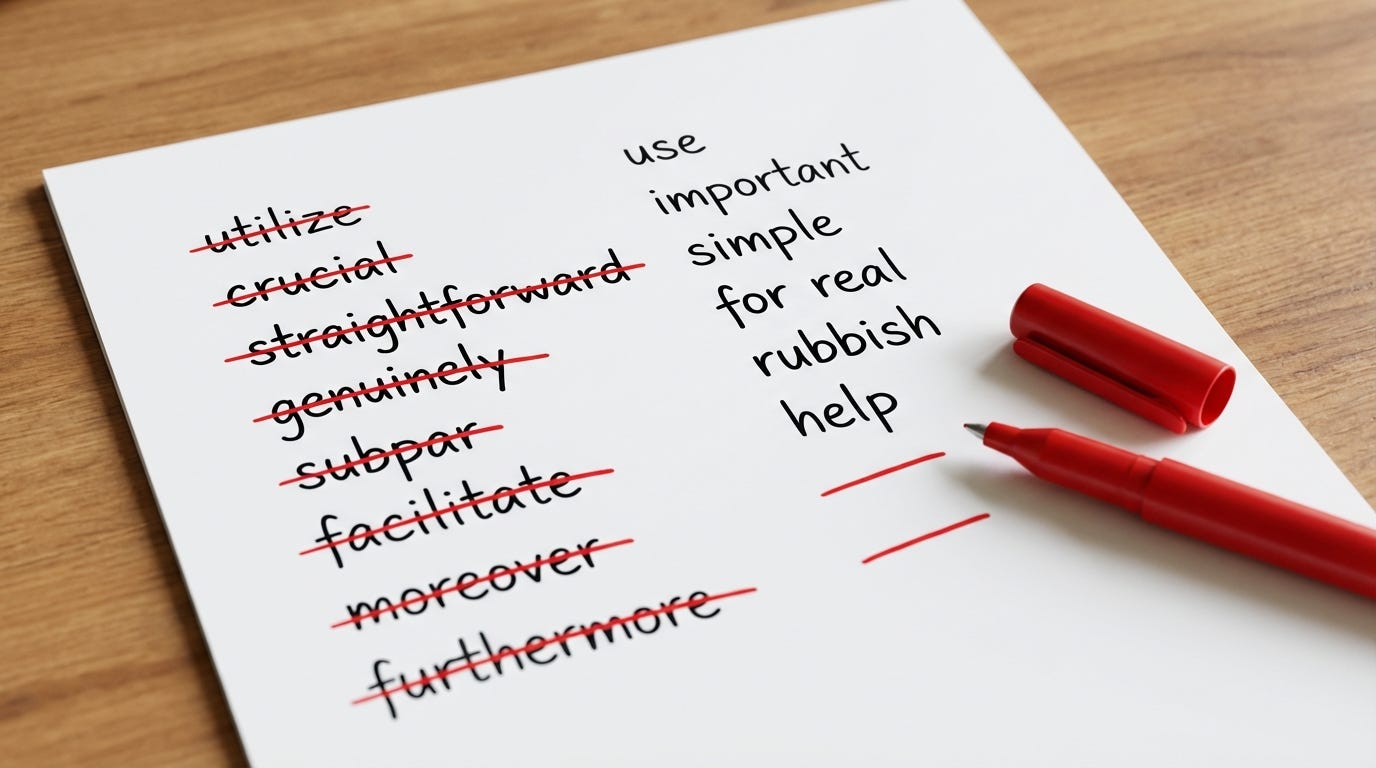
The list started small. AI kept using “straightforward” in my drafts. I NEVER say straightforward. I say “simple” or “clear” or sometimes just “obvious.” So I wrote it down.
Then I noticed “delve.” Then “crucial.” Then “moreover” and “furthermore.” The list grew. At last count it sits at over 40 words and phrases, and I’m still catching new ones. (I found two more this week.)
How I Built the List
Every time I read an AI draft and something made me pause, I paid attention. Not to whether the sentence was technically correct but to whether those words would actually come out of my mouth if I were talking to a friend over coffee.
In every draft AI was choosing words I would never choose. They felt too formal and too polished. And also measured and careful in a way I never am. It was writing like AI, not like me, and I was putting my name on it. And that felt inauthentic. So every cringe word became a rule. “That doesn’t sound like me” went straight into what eventually became my guardrails document. I’m still building it. The document is a living thing because AI keeps finding new ways to sound like AI.
Skip this step and you’ll publish content for months thinking it sounds fine. Then one day you’ll read your own posts back to back and realize none of it sounds like you wrote it. Ask me how I know.
The Patterns
Once you see the patterns, you can spot AI writing in about 2 seconds.
Em dashes are everywhere in AI writing. AI uses them as its default connector for everything. “She wanted to start a business — but she didn’t know where to begin.” I strip every single one. If the sentence needs a pause, use a period, a comma, or start a new sentence. For better or worse and much to the chagrin of seasoned writers who love a good em dash and have used them for years, em dashes are one of the fastest ways to spot AI content in the wild.
Mirrored contrast is the other dead giveaway. AI loves the “it’s not X, it’s Y” construction. “It’s not about perfection, it’s about progress.” It sounds profound but says almost nothing. Once you notice this pattern you will see it in every AI draft and in half the content on the internet right now.
Formality markers are the most obvious. “Utilize” instead of “use.” “Facilitate” instead of “help.” AI defaults to the fancier version of every word because it was trained on formal text. Real people don’t talk that way. They just don’t.
I caught one last week. AI wrote: “This is a crucial consideration for anyone producing content at scale.” I changed it to: “This matters if you’re making content and want people to actually read it.” The point didn’t change. But read those two sentences back to back and tell me which one sounds like a human being wrote it.
Then there’s the hedging. “Somewhat,” “arguably,” “it could be said that.” AI hedges constantly because it’s trained to be safe. And it makes everything sound uncertain, like you’re not sure you believe your own argument.
Connector words nobody actually says out loud. “Moreover.” “Furthermore.” These are academic writing patterns and they make everything feel like a term paper.
And the artificial enthusiasm might be the worst offender. “Exciting,” “game-changing.” If your idea is actually good, you don’t need to announce it. The reader knows.
So What Do You Replace Them With?
Knowing what to cut is only half the problem. If you don’t know what YOUR words actually are, you just end up staring at a draft full of holes with nothing to fill them with. The ban list is useless without knowing your own voice well enough to write the replacement.
My replacements come from how I actually talk. I recorded myself telling a story for about ten minutes, transcribed it, and studied the words I gravitate toward when I’m not thinking about writing. That ten minutes taught me more about my actual voice than I expected.
I say “rubbish” where AI would say “subpar.” “For real” instead of “genuinely.” Fragments are fine with me. Starting sentences with “And” and “So” is how I actually communicate. AI writes in complete, grammatically perfect sentences every single time, and that’s exactly the problem.
Your list will look different from mine. The words AI keeps inserting that you would NEVER use? Those are the ones to catch. And you’ll probably be surprised how many there are once you start paying attention.
The Real Cost
AI generates the most average version of whatever you asked for. It pulls from everything it’s been trained on and produces the most common words and the most common structures. That’s how the technology works. And the most common version of anything is GENERIC.
So every word AI chooses that you wouldn’t choose is your voice disappearing. One word won’t kill you. But forty of them scattered across a 1,000 word article? Your readers aren’t hearing you anymore.
They might not think “this was written by AI.” But they’ll scroll past without engaging and the connection just won’t be there. I watched this creator I respect have a crazy drop in engagement over about a six week period. She didn’t change her topics or her posting schedule. The only thing that changed was she started publishing AI drafts without editing for voice. Her audience couldn’t name what was different, they just stopped responding. People do that when they can feel something is off but they just can’t put their finger on it. And she’s smart. She’s good at what she does. That’s what makes this so frustrating. She started using AI to save time and it ended up stripping the personality out of everything she posted.
A banned word list sounds like a small thing. It is. But small catches, done consistently, are what keep your voice in your content. Skip them and AI replaces you one word at a time.
I know because I’ve done it to myself. Published an entire Substack article I thought was one of my better ones, then read it back a week later and realized the voice was gone. The words were right but none of it sounded like me.
Speaking of the platform we’re on right now, Substack is one of the few places where voice matters more than polish. People subscribe here because they want to hear from a real person. Which makes this the worst possible place to let AI make you sound like everyone else.
Since I’m talking about this, I should tell you. This article you just read? AI drafted it. Then I ran it through my guardrails system, caught the patterns, made the replacements, and edited until it sounded like me. That’s the process. You just experienced the output.
The banned word list is one piece of a much larger system. I put together everything I use to keep my AI content sounding like me into one resource. AI Writing Guardrails: Because “make it sound more human” was never going to work includes my complete 92-rule guardrails framework, a guided guardrails builder that helps you create your own custom system, a voice sample template with instructions, the 5-pass editing process I use on every piece of content, a quick start guide, and an annotated case study showing exactly how I built mine.
If you’re tired of reading your own AI drafts and thinking “this doesn’t sound like me,” this is how you get it sorted.
Click here to get the AI Writing Guardrails