


I use AI every single day. It helps me write, research, plan, create images, edit video, and build systems that would have taken a team of people five years ago. I’m a huge advocate for learning these tools and using them well.
But I’ve also learned where the limits are. And honestly, those limits are a relief.
Because if AI could do everything, what would be the point of you? Why would anyone need your voice, your perspective, or your presence? The fact that AI has real limitations means there’s still a reason for you to show up. And these are the things I’ve found AI genuinely cannot do, no matter how good the tools get.
When it comes to options, AI is great. It can analyze data, present scenarios, and weigh pros and cons. It can even make recommendations. What it cannot do is decide. It can’t tell you which business to build, whether a partnership aligns with your values, or if an opportunity is right for your family. It can’t tell you when to say no. Decision-making requires something AI doesn’t have: skin in the game. You’re the one who has to live with the consequences, who knows your actual priorities, your convictions, and what you’re willing to sacrifice. AI can inform your decisions, but it cannot make them for you. That responsibility stays with you.
Responding faster? AI can help with that too. Drafting emails, suggesting replies, mimicking conversational tone. But it cannot actually know the person on the other end or care about them. Trust is built through presence, consistency, and genuine attention over time. Your audience can feel when a response is real versus templated, even if they can’t articulate it. The people who succeed long-term in online business are the ones who actually engage, who respond to comments with something real and remember details about the people in their community. They show up as humans. AI can help you manage communication at scale, but the relationship itself is still yours to build.
Train it well enough and AI can mimic your writing style, matching your sentence patterns and vocabulary. What it cannot do is know what you actually believe and why. Your convictions come from your life: your experiences, your failures, your faith, and the conclusions you’ve drawn from what you’ve seen. AI has access to none of that unless you tell it, and even then, it’s just working with words. It doesn’t hold those beliefs or have the conviction behind them. This is why AI-generated content often feels hollow even when it’s technically well-written. There’s no weight behind it. No one standing on anything. Your voice matters because it’s connected to something real. Don’t let AI flatten that.
And this one should be obvious, but I’ll say it anyway: AI cannot tell you what God is calling you to. It can’t pray for you or discern the Holy Spirit’s leading. It can’t tell you whether a decision aligns with your calling or just your ambition. It has no access to the spiritual dimension of your life and work. I’ve watched people try to use AI as an oracle, asking it questions that require wisdom, not information. That’s a dangerous trade. You’re swapping communion with God for a language model that’s just predicting the next word. Use AI for what it’s good at, and go to the Lord for what it can’t possibly understand.
AI can generate content all day long, but it cannot evaluate whether that content meets your standard. This one catches people off guard. It doesn’t know what “good enough” means for your brand, your audience, or your conscience. You still have to review everything and decide if it’s true, if it’s helpful, if it sounds like you, and if it serves the person reading it. The quality control function cannot be automated away. If you’re publishing AI output without review, you’re letting it run your business. And you’ll pay for that eventually in trust, in reputation, or in results that don’t convert because there’s no human judgment behind them.
AI is great at telling you what you could do. It can generate a hundred ideas in a minute and show you every possible strategy, tactic, and approach. What it cannot do is tell you which one is right for you. Should you launch that course or focus on affiliate income? Should you be on TikTok or Instagram, hire help or stay lean? These questions require wisdom, self-knowledge, and an understanding of your own season and capacity. AI can brainstorm with you. It can pressure-test your thinking. But the “should” question is yours to answer.
Your business needs you in it. Your presence, your attention, and your willingness to be seen. AI can help you create content faster and plan your week, but it can’t be present in your community or do the work that actually matters. Even with AI avatars that look and sound like you, someone still has to decide what to say, what to build, and what direction to take. The people who win are still the ones who show up consistently, who put their perspective out there, who build something that’s unmistakably theirs. AI makes that easier in a lot of ways, but it doesn’t replace the requirement.
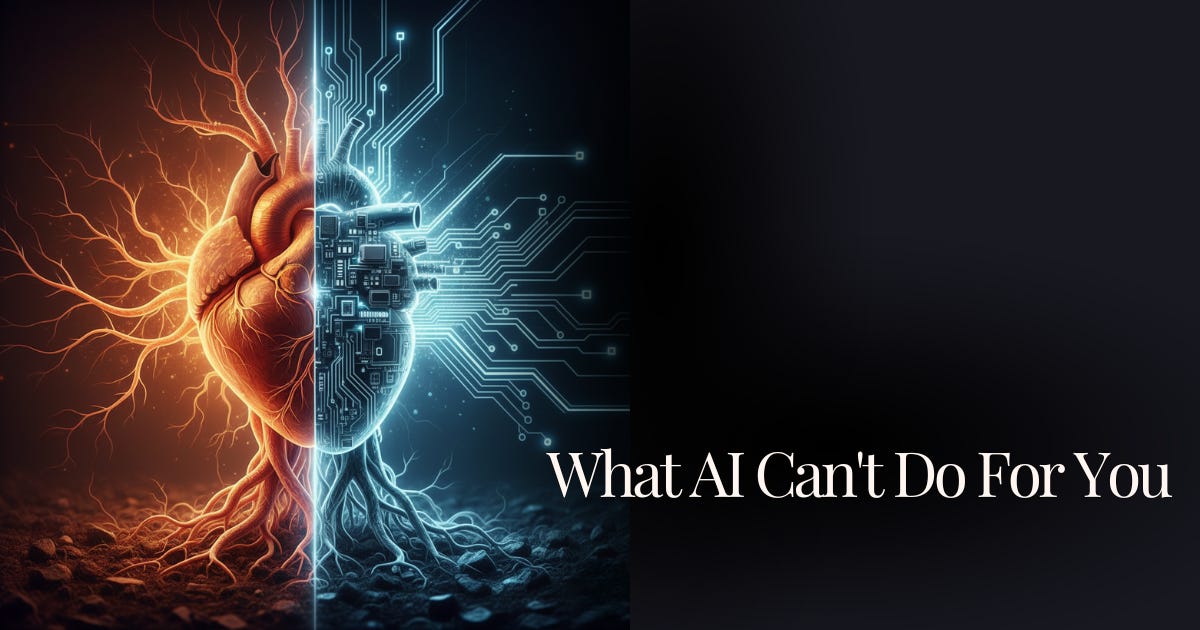
I find all of this encouraging. AI has made the parts of you that are irreplaceable more valuable: your discernment, your relationships, your convictions, your faith, your judgment, and your presence. These things matter more now, not less. Anyone can generate content with AI, but bringing wisdom to what you create, building genuine trust, and leading with conviction still requires a human. The tools have gotten better, but the human requirements haven’t changed. You still have to show up, decide, and care.
AI is a tool. A powerful one. But it works for you, not the other way around. Keep it in its proper place and it will serve you well. Let it creep beyond its limits and you’ll lose the very things that make your work valuable.
Use AI for leverage. Bring yourself for everything else.
If you’re trying to figure out how to use AI without losing what makes you you, the AI Revolution Secrets training walks through exactly how to build AI systems that serve your business without replacing your voice, your judgment, or your presence. Register and I’ll see you there.