


I watched myself disappear once. It happened so slowly I didn’t even see it coming.
Back then it was optimization. Systems. Funnels. I was chasing more output, more scale, more revenue and I got very good at producing content that performed. Somewhere in that process, I stopped saying things I actually believed. I just said whatever converted.
By the time I realized what had happened, I was miserable. My marriage was falling apart. I had been away from my children for five months. My health was failing. I had optimized myself into someone I didn’t want to be.
I’m telling you this because I see the same pattern emerging with AI. AI is a different tool, but the enemy’s playbook hasn’t changed. It creates more output, more reach, and more efficiency. If you aren’t careful you get wrapped up in that same spirit of striving and seduction, chasing money and worshiping at the altar of productivity. Ultimately you end up losing your authentic self, your voice and your humanity.
The Theft Happens Slowly
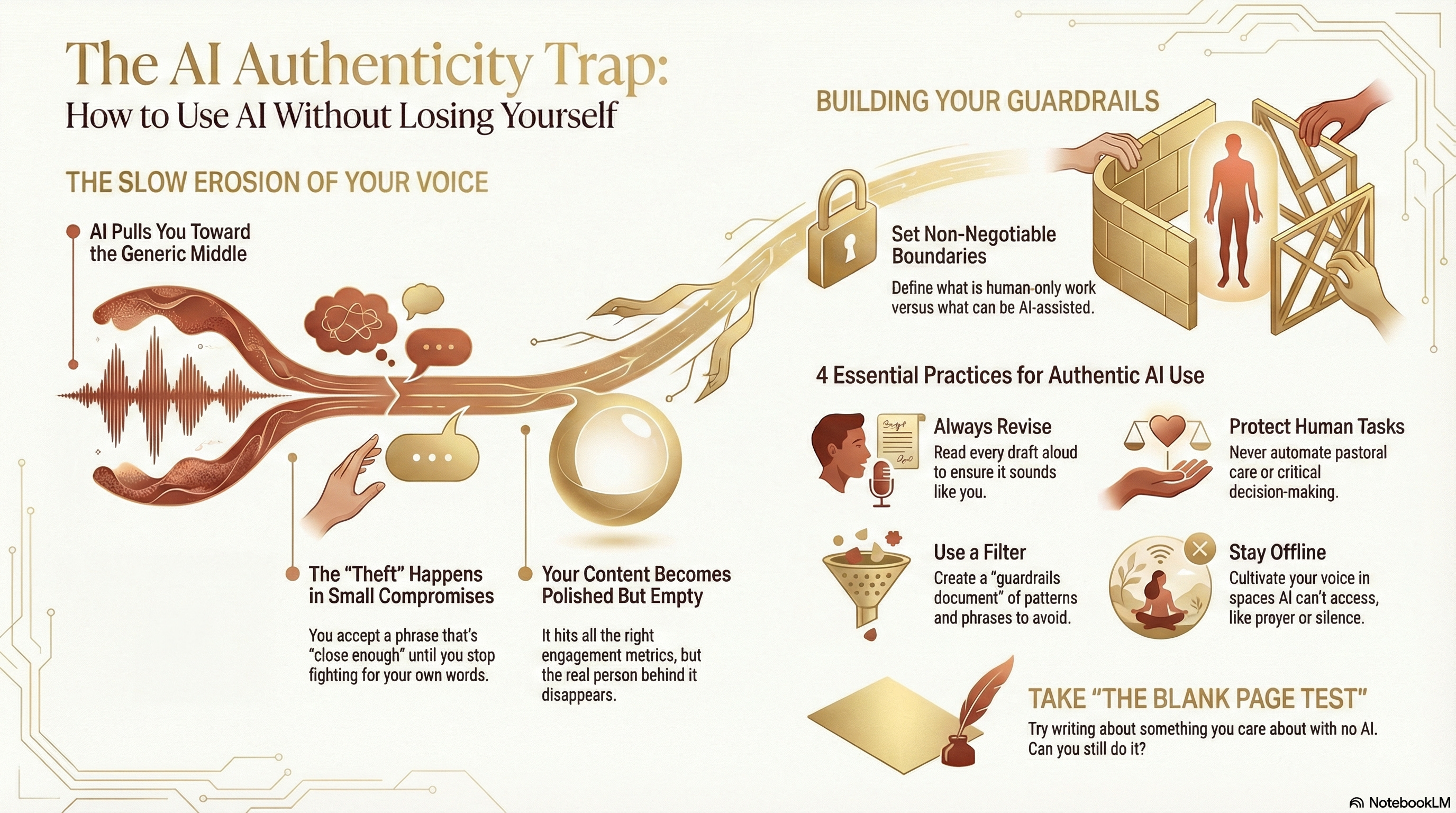
Nobody wakes up one day having lost their voice. It happens in small compromises. You let AI smooth out an edge that felt too sharp. You accept a phrase that sounds professional even though you’d never say it that way. You stop fighting for the sentence that captures exactly what you mean because the machine’s version is close enough.
Do that enough times and one day you look up and don’t recognize yourself.
I’ve watched creators I respect slowly become indistinguishable from each other. Their content is competent and their hooks are optimized and their posts hit all the right marks. And there’s nothing underneath. Their content is polished but empty because there’s no real person behind it anymore.
The algorithm rewards this. Engagement stays steady, growth continues, and by every visible metric, the strategy is working. But the person is hollowing out. Most of them don’t even notice until they can’t write a single paragraph without asking a machine what to say.
This Is a Spiritual Problem
There’s a spiritual dimension to this that most AI educators don’t talk about.
You are made in the image of God. Genesis 1:27. Your capacity to create and communicate and speak truth into the world is fundamental to who you are. Your voice, your particular way of seeing and saying things, is part of how you image your Creator.
When Proverbs 4:23 says to guard your heart because everything flows from it, that includes your words and your content and the things you put into the world that shape how others think and believe. What you put out into the world reflects what’s been shaping you.
AI shapes the people who use it, just like every tool does if left unchecked. Unless you’re intentional about how you use it, it will shape you instead of you shaping it.
There’s a pattern everyone is following and a mold everyone is fitting into. The pressure to conform is real because fitting in gets rewarded and standing out is risky. The people who lose their voice to AI aren’t usually making a conscious choice to abandon their convictions. They just keep taking the easy route, one prompt at a time, until one day they realize they’ve stopped saying anything real.
What the Erosion Actually Looks Like
You sit down to write about something you care about. Your faith, a business principle you’ve learned through hard experience, a warning you feel compelled to give. You open your AI tool and you prompt it, and what comes back is... fine. It’s structured well and sounds credible. But it’s missing the thing that made you want to write it in the first place.
So you try to edit it. You push back on certain phrases. You ask for more directness. And the machine complies, sort of. But there’s still something off. The heat is gone, and the conviction has been translated into content. Something essential got lost in the translation.
You publish it anyway because you’re tired and it’s close enough. That’s how it starts.
Over time, you stop noticing the gap between what you meant and what got published. Your sense of your own voice gets weaker because you stopped using it.
I talk to people regularly who tell me they used to be good writers. They had a voice and people responded to their words. And now they feel like they can’t write anything without AI, and even with AI, nothing they produce feels like them anymore.
The Harder Truth
I’ve had to face something uncomfortable about my own use of AI.
AI learns from millions of people’s content, so it naturally produces stuff that sounds like... everyone. It pulls toward the middle. The safe, expected, and very generic middle.
When you use AI without strong guardrails, you are being pulled toward that generic center. The things that make you unique, your writing quirks and idiosyncrasies start getting smoothed out and eventually they disappear. This is useful if you’re trying to sound professional and you don’t know how. It becomes a problem when you actually have something to say.
The prophetic voice has never been average or safe or optimized for engagement. When Jeremiah spoke, it cost him everything. The voice that speaks truth clearly has always been a voice that refuses to play it safe.
And look...I’m not comparing anyone’s Substack to the prophets. But if you actually have something to say, letting AI smooth it out is unfaithful to what you’ve been given to carry.
The Guardrails I Actually Use
I use AI every day. I’m not a purist about this. But I’ve built hard boundaries into how I work with it, and these boundaries are non-negotiable.
AI never touches spiritual counsel. When someone comes to me with a question about faith or discernment or what God might be asking of them, I do not prompt a machine for the answer. That requires me to actually be present with the person in front of me. You can’t automate pastoral care.
I also don’t let AI make decisions for me. It can gather information and outline options and draft language I might use. But the act of deciding and committing to a direction and taking responsibility for a choice stays human, always.
Nothing gets published without my review and revision. Every piece of AI-assisted content goes through my hands before it reaches anyone else. I read it aloud and check it against what I actually believe. I ask whether this sounds like something I would say, and if it doesn’t, I rewrite it until it does.
I built a guardrails document with over 100 specific patterns to avoid. It includes phrases that scream “AI wrote this,” structures that feel formulaic, and habits that flatten voice into generic professional tone. I include these guardrails when I prompt, and I check against them when I review output. This is protection for my voice.
And I maintain regular practices that are entirely offline. Scripture study and prayer and silence and time with my son and conversation with my husband. These are the spaces where my actual voice gets formed. It’s where I remember what I think and why I think it, and where I stay connected to the Source that gives my words any weight in the first place.
AI cannot access those spaces. And if I let my life become so optimized that those spaces disappear, I will have nothing left worth saying, no matter how efficiently I can say it.
The Test
If you want to know where you actually stand, try this.
Close your AI tools, all of them. Sit with a blank page, physical or digital, and write about something you care about. No prompting, no assistance, just you and the page.
Can you do it? Does anything come, and if it does, does it sound like you? Like how you talk to a close friend or pray or think when no one is performing for an audience.
If you can’t do this, or if what comes out feels foreign compared to what you’ve been publishing, then something has been lost. But you can get it back.
The voice is still in there. But it needs to be exercised again and trusted again and given space to exist without optimization.
The Invitation
I’m asking you to use AI like someone who knows what they carry.
You have a voice that was given to you. The particular way you see the world and the convictions you hold and the experiences that shaped how you think are the substance of your witness.
The goal is to stay yourself while using these tools, and to stay human in an environment that rewards becoming interchangeable.
That’s what stewardship actually looks like.
If you want to learn how to build AI systems that actually serve your work without eroding your voice, the AI Revolution Secrets training is where I’d start. It’s free and practical and built for people who want to use these tools with wisdom.