


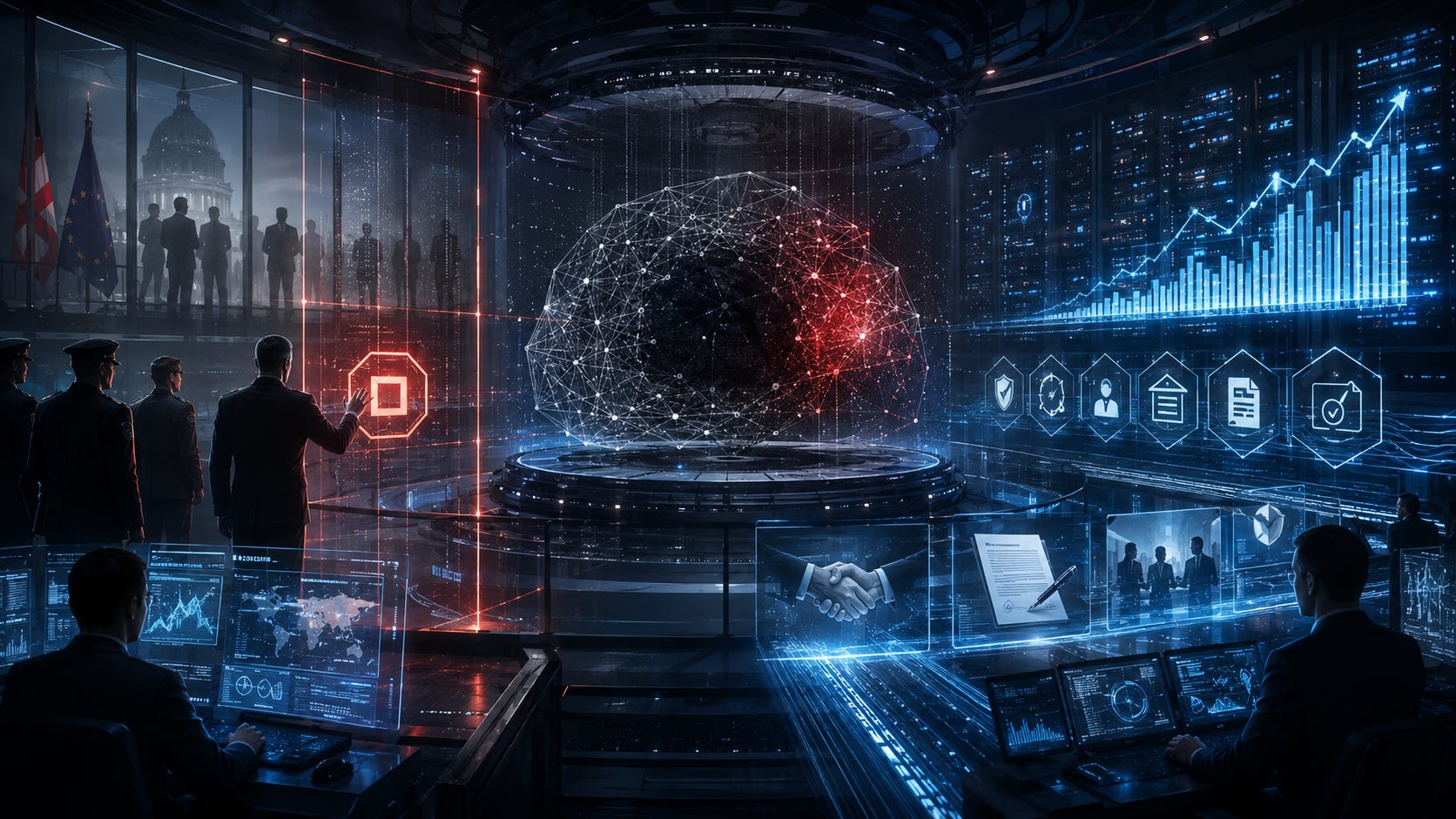
This month the US government ordered Anthropic’s two most powerful models switched off, citing national security. They’re still offline. The shutdown didn’t come out of nowhere either. Anthropic has been fighting the administration since February, when the Pentagon branded it a supply chain risk, the kind of label usually reserved for foreign adversaries. The company is suing over that one.
The company taking all this fire is also the most valuable AI company in the world.
And it’s getting richer by the day. Anthropic is on track to pull in around $47 billion this year. In January the projections were $9 billion, so it’s grown about five times over in five months. Investors just poured another $65 billion in. That makes the company worth close to a trillion dollars. It’s taken the first step toward going public. The best model it owns got switched off, and the money didn’t so much as DIP.
Three Days, Then Gone
On June 9, Anthropic released Fable 5, the most capable model it had ever put in public hands. Three days later the US government sent a letter and it was gone. It wasn’t a crash or a bug. Citing national security, the Commerce Department hit the model with export controls, the same rules the US uses to keep sensitive technology out of foreign hands. The order told Anthropic to block anyone who wasn’t a US citizen. Anthropic couldn’t enforce that selectively, so it pulled Fable 5 for everyone on earth. Launch to global blackout in just 96 hours.
The reported trigger was a jailbreak. Amazon’s people apparently got the model to cough up restricted cyberattack information, flagged it to the administration, and the government moved. Anthropic says the concern is overblown, that every safeguard in the industry has holes like this, and the whole thing is a misunderstanding it’s working to fix. The administration says a model that can run a cyberweapon is serious and Anthropic refused to patch it. I don’t really have a dog in the race on this one. I feel like both things can be true at once and we will just have to see how this one shakes out.
But one detail does make the whole thing stranger. There are independent tests that rank these models on how well they handle real work, and coding is one of the toughest. When Fable 5 got pulled, it was sitting at number one on a major coding test, three points ahead of OpenAI’s best model. The government pulled the most capable AI on the planet, by the exact measure the whole industry uses to keep score. And being the best is part of why it got pulled. The more powerful a model gets, the more the government starts treating it like a weapon.
The Money Was Never in the Flashy Model
Anthropic’s revenue didn’t move when Fable 5 got shut down, because the business doesn’t depend on it. The company’s cash engine is actually the boring stuff. Claude Code, enterprise contracts, and the governance-heavy, compliance-heavy work that big regulated companies pay serious money for. The day before the shutdown, Anthropic signed a deal with Tata Consultancy Services, one of the biggest IT firms in the world, to put Claude in front of 50,000 employees across 56 countries, aimed straight at finance, healthcare, and life sciences. Those buyers needed an AI they could trust with sensitive data, one that wouldn’t get them in trouble with regulators. That’s what Anthropic sells them, and it has nothing to do with which model scores highest on a test.
The flashy model got all the headlines, then got shut down. The money kept coming anyway, from the quiet enterprise work that nobody obsessing over AI bothers to look at.
You’re Watching the Wrong Number
Everywhere I look, people are sprinting after the newest, shiniest, most powerful tool. A new model drops and everyone scrambles to rebuild their stack around it. A bigger context window or a better benchmark gets released and the herd moves.
Anthropic just showed you, in public and at trillion-dollar scale, that the most capable tool in the room is also the most fragile. It can be switched off by a letter you’ll never see, over a fight you’re not even part of. My own automations broke when Fable got pulled, even though I’d built them on a different model, and I lost time resetting them. Anthropic didn’t feel a thing.
What actually lasts is the trust underneath all of it, and I built my whole framework for making money with AI around exactly that, long before Anthropic proved it at this scale. I call it the M.A.P., short for Model, Automation, and Proof, and Proof is the part that matters here. Proof is how you earn trust, through clean positioning, showing your work, and keeping your word. Not the flashiest tool you own. That’s what survives a bad week, and it’s what kept Anthropic standing. Its model got pulled and the enterprise business never flinched.
Five Days Later, the G7 Sat Down
Five days after Fable 5 went dark, the G7 met in Évian, France, and on the final day the heads of state had lunch with the people who build this technology. Sam Altman, Dario Amodei, Demis Hassabis, sitting across from Trump and Macron as equals.
That meeting made one thing clear. Governments are moving to control who can use the most powerful AI, and they’re deciding it by nationality. The Fable 5 shutoff was the proof. For the first time, the US treated access to an AI service like a weapons export, something it can legally block based on what passport you hold. The other six countries were not happy to be on the wrong side of that switch. Macron called it strictly nationalist.
And the people building it asked for more of the same. At that same lunch, Amodei and Hassabis called for a US-led coalition that would keep the most powerful models inside a circle of trusted democratic allies. They asked governments, out loud, to hand it out by alliance.
So the best AI is turning into something you get based on your citizenship and your country’s politics, not something anyone can simply buy. That’s the bigger story under the Fable 5 shutdown, and it points where access to AI is heading.
If your income rides on the most powerful tool, you’re depending on decisions made in rooms you’ll never sit in. That alone is reason to build on something no government can switch off on you.
What I’d Do With This
Pick the tool that fits the work, not the one topping the leaderboard this month. The frontier model is fun to play with and a shaky thing to stake recurring revenue on.
Build your trust layer first. Your positioning and your proof. The stuff that lives in you, not in a vendor’s data center. That’s the asset no directive can switch off, and it’s the one Anthropic just rode through a national security scandal without a scratch on the balance sheet.
And stop treating benchmark scores like they’re the scoreboard for your business. They aren’t. The scoreboard is whether people trust you enough to buy and stay.
The tool you pick matters waaaaaay less than the foundation you build it on. That’s the part the prompt-pack crowd will never put on their sales page.
I broke this whole approach down in my AI Monetization Map. Seven realistic income paths, the M.A.P. system that puts trust and fit at the center instead of hype, and a 30-day plan to get from idea to first revenue. No overnight promises, no chasing the loudest tool in the room. It’s free. https://im.aiwithleah.com/new